https://www.youtube.com/watch?v=7RpFJ4PnYu8
Monday, 2 February 2015

Saturday, 31 January 2015
Solve Hoof Health Problems
By
Natalie DeFee Mendik |
January 30, 2015

What steps can you take to get the best hooves possible, and what are some common hoof problems you may face? Vernon Dryden, DVM and certified journeyman farrier of Rood & Riddle Equine Hospital in Lexington, Ky., answers these questions and shares some expert advice for dealing with hoof woes, from thrush-busting to abscess blues.

Diligence
The easiest yet most critical component of your hoof-care tool kit is to pay attention and stay on the ball. Regularly pick out your horse’s feet, checking for any abnormalities such as loose clinches or sprung shoes on shod horses, heat, cracks or thrush. "Be aware, be a good all-around horseman, and be cognizant of different hoof abnormalities,” says Dryden.
Next up is good housekeeping. Avoid exposing your horse to excessively wet, muddy or rocky conditions. "Keep the horse in a good environment,” recommends Dryden. "You can’t expect a horse to thrive in mud, feces and urine, or a rocky field.”
While exposure to rocky terrain can lead to bruising and abscesses, increased bacterial growth from wet and muddy conditions can result in ailments like thrush and white line disease. In addition, wet-dry cycles can cause the hoof to expand and contract, causing cracks and loosening clinches.
Like Clockwork
Quality, regular farriery is paramount to good hooves. "The best thing a horse owner can do is to identify a qualified farrier to regularly trim or shoe their horse’s feet on a four- to six-week shoeing or trimming cycle to maintain a nice, solid foot,” notes Dryden. Farrier care is not a place to pinch pennies. Don’t try to stretch out a shoeing cycle, and don’t settle for the lowest bidder just to save a buck. You will get what you pay for.
|
If your horse isn’t graced with optimal hooves, you may want to consider a hoof supplement. While proper nutrition always comes first, a quality supplement can be helpful if your horse is still lacking in good, strong hoof growth.
"If a horse is deficient in a trace mineral or an amino acid that is important for developing hooves normally, then supplements may be beneficial,” says Dryden. "I think hoof supplements definitely have a place, and I use them on cases that I feel may not be getting as much nutritional value as they should.” He recommends a supplement containing biotin and methionine, which are thought to bolster hoof resiliency and aid in growth.
Along with supplements, hoof dressings have a place in the hoof-care arsenal. "Topical hoof treatments depend on the environment and the quality of the foot,” explains Dryden. "If the horse has very dry, flaky hooves, it may be best to apply a moisturizing topical. If the horse has extremely soft feet that aren’t holding together well, it may be beneficial to apply a hardening topical, like Keratex, to maintain more rigidity.”
Hot Spots
Even with great care, horses can face their share of hoof ailments. Here are some common issues you might face.
Thrush: Everyone has experienced the stinky smell of thrushy feet, but did you know that untreated thrush could actually lead to lameness? Thrush is caused by anaerobic bacteria invading the frog tissue from the sulci (grooves alongside the frog), and is characterized by a foul-smelling, black-colored sludge. Daily hoof cleaning can help keep thrush at bay, although other factors may come into play, such as full hoof pads or insufficient exercise, both of which reduce the hoof’s natural ability to shed debris. Upright hoof conformation with deep frog sulci can also predispose a horse to thrush. Store-bought treatments applied according to the manufacturers’ or your veterinarian’s directions can help resolve thrush. However, regular hoof-picking and maintaining a clean environment for your horse are the best methods for preventing this hoof ailment.

Soaking a hoof to treat an abscess.
Abscesses: One day your horse is sound; the next day he’s extremely lame and may also have a bounding digital pulse in one foot, heat around the coronary band, and swelling up the pastern. This is a well-known scenario that usually indicates a hoof abscess, a relatively common occurrence involving a local infection and pus buildup within the hoof. If your horse is severely lame, call your vet first to discuss the issue; if she thinks it’s an abscess, in many cases it will resolve with treatment you can administer yourself.
Abscesses are often the result of hoof bruising or bacteria invading the hoof via a crack or misplaced nail from a recent shoeing. Luckily, abscess treatment tends to be pretty straightforward, usually involving draining the infected area, soaking, poulticing and hoof wrapping. However, if the abscess does not resolve in a couple of days, it may be necessary to get your veterinarian involved due to the possibility of the infection from the abscess invading a deeper structure, such as the coffin bone.
Chronic, low-grade laminitis: "Many horse owners don’t even realize that their horses have chronic, low-grade laminitis,” remarks Dryden. These horses are plagued by off-and-on mild lameness and may be older and categorized as metabolic, insulin-resistant, or Cushingoid (having Cushing’s disease). Using lab work and imaging diagnostics, your veterinarian can identify abnormalities and formulate a treatment plan encompassing dietary needs, medical management, exercise, grazing/turnout routine, and therapeutic shoeing options.
White line disease: Looking at the sole of your horse’s hoof, you can see the junction between the outside hoof wall and the sole, known as the white line. This white-shaded line runs the perimeter of the sole where it meets the hoof wall. Bacteria and fungus that cause white line disease are found everywhere in the environment. These microorganisms are typically anaerobic and consume the white line just inside of the hoof wall. This may lead to separation of the wall, instability of the hoof capsule, and even mechanical laminitis/coffin-bone rotation. Microorganisms typically find their way into the hoof via compromised areas of the white line, such as a weak and cracked hoof wall.
Your veterinarian and farrier will be able to determine the extent of the white line disease and formulate a plan for treatment. Often the diseased area of the hoof must be removed, then treated topically; your veterinarian can recommend products, which can range from a simple chlorine-based solution to commercial products such as White Lightning or CleanTrax. Preventing white line disease is far easier than treating it. Like thrush, white line disease may be circumvented by proper hoof care and good hygiene.
Regardless of whether your horse experiences these hoof problems or one of the many others out there, a skilled vet and farrier team, along with timely intervention, is essential to his well-being.
A little effort goes a long way. "Pick out and care for your horse’s feet daily,” says Dryden. "Take note of patterns and changes. And most importantly, invest in routine farrier care with a qualified individual.” Stay on top of things; you’ll know if your horse’s hoof care is working when he’s sound, even and balanced.
Sunday, 18 January 2015
Hoof Anatomy, The Outer Structures
Photo: Alexandra Beckstett, The Horse Managing Editor
The hoof's external health affects the bones and soft tissues within, and vice versa
Many horse owners go their whole lives caring for horses’ hooves with little knowledge of the hoof capsules’ inner workings—the interaction of the bones, tendons, ligaments, and other parts that lie beneath. They might be aware of how the hoof’s outer condition reflects its external health, but the hoof’s appearance also provides a wealth of information on its internal well-being. It’s much more than just a covering for the end of the limb or the equine equivalent of the human fingernail.
Long-term hoof imbalances put excess strain on the
bones and soft tissues, potentially compromising the structures’ shape
and sturdiness long-term. Conversely, damaged or misshapen internal
structures can effect congruent changes in hoof shape.
In part 1 of this series we described internal hoof
structures and common problems. Now we’ll put it all together by
discussing external hoof anatomy, common problems, and how they relate
to the internal structures.
External Hoof Anatomy
When you look at the hoof as the horse stands, you are seeing the hoof wall. It grows down from the coronary band, the junction between the hoof and the skin. The toe is closest to the horse’s nose, the heels are closer to his tail, and the quarters are between.
If you pick up the hoof to look at the bottom, you
will see the wall wrapping around the outer edge and the white line just
inside of it (easier to see in a freshly trimmed foot). Moving rearward
from the toe, you’ll find the sole that covers the majority of the
hoof’s bottom. There is also a triangular elastic structure pointing
forward from the heels called the frog (which aids in shock absorption).
In the center of the frog and on either side are grooves called the
central and lateral sulci. Lastly, we have the heels directly behind the
frog and the bars at the rearward ends of the hoof wall, where the wall
turns inward and then forward away from the heels.
Most healthy hooves have the following characteristics, says Amy Rucker, DVM, owner of Midwest Equine, in Columbia, Missouri.
- Heavy (thick) hoof wall with wide, even growth rings from toe to heel.
- Significantly shorter heels than toes.
- A white line that is tight and uniformly wide through the toe, then slightly narrower in the quarters.
- A heavy/thick (not flexible or overly sensitive) sole with some cup (not flat).
- A frog that is neither recessed up into the foot, with deep sulci, nor protruding down past the sole.
- Heel bulbs that are not contracted (narrow with a deep groove running into the central sulcus of the frog).
Also consider the following signs of hoof health:
- When viewing the foot from the side, drop an imaginary vertical line down from the front of the coronary band to the ground. Two-thirds of the foot’s ground surface should be behind that line. Draw another imaginary line up from the rear edge of the heels where they touch the ground; it should intersect in the rear third of the coronary band (weak heels run further forward).
- When viewed from the front, the coronary band should be parallel to the ground from left to right, sloping gently and evenly down from toe to heels.
- Hoof wall tubules (the “grain”) should go straight down the wall to the ground, not diverting left or right.
- The angle the heel makes with the ground should be similar to that of the toe, but it is often a few degrees less.
- The hoof should be roughly as wide as it is long.
- The frog’s width should be 60-70% of its length, adds Stephen O’Grady, DVM, MRCVS, of Northern Virginia Equine.
Hoof Evaluation
Aside from looking for obvious injury, “Visual examination of the foot—its growth pattern, shape, and external characteristics—hints at internal areas of the foot that bear more ‘load’ or stress (and, thus, need unloading),” explains Rucker.
Increased stresses on parts of the hoof can have three results:
- Wall deviation or bending (flaring outward or rolling/running under);
- Pushing up of the coronary band; and/or
- Decreased hoof wall growth, evidenced by growth rings that are closer together in a stressed area, O’Grady says.
The hoof doesn’t exist in a vacuum, however—O’Grady
encourages owners to also consider limb conformation, which can change
how forces are distributed within the hoof capsule, leading to hoof wall
deformation.
Common Hoof Problems
Let’s start with the problems that involve damage and disease of outer structures, then we’ll move on to problems related to hoof balance.
With puncture wounds
from stepping on a nail or similar sharp object, the real risk isn’t
the hole, but the expressway it provides for bacteria to get deep inside
the body and cause infection. Rucker strongly recommends leaving the
object in place if possible until the veterinarian can radiograph (X
ray) the foot to see what internal structures are affected.
Scarring from coronary band damage can cause altered hoof growth below the injured area for the rest of the horse’s life.
“These injuries need to be bandaged and treated to restore alignment of hoof tubules for healthy future growth,” Rucker advises.
“Visual examination of the foot hints at internal areas of the foot that bear more load or stress.”
Dr. Amy Rucker
Minor chips, cracks, and missing chunks of wall might
be nothing to sweat over, but more serious damage such as deep quarter
cracks and large missing pieces of hoof can be much more painful and
problematic.
“If you have a large chunk of the hoof missing with
bleeding, have a vet out because the horse may need a pressure wrap to
keep the wall from bulging and regrowing incorrectly,” says Rucker. “The
vet can also radiograph quarter crack cases to help the farrier treat
them,” based on any internal damage that might have happened.
Abscesses
are pockets of infection (like pimples) that can break open at the
thinner coronary band area or rupture through the sole/white line. Once
the abscess bursts, lameness improves immediately because of the reduced
pressure.
“Anytime a horse is non-weight-bearing lame, I worry
about a fracture or septic (infected) tendon, but it’s usually an
abscess,” says Rucker. “They’re horribly painful, and (a non-steroidal
anti-inflammatory such as) phenylbutazone (Bute) won’t resolve the
pain.”
White line disease
is an opportunistic fungal or bacterial infection that strikes where
the wall is already stressed or cracked, softening the inner hoof wall
so it crumbles and allows outer wall layers to detach.
“You have to remove enough wall to get air to affected
areas (to help kill the microbes breaking the wall down), support the
remaining foot with a special shoe, and lay the horse off while the wall
regrows,” says Rucker.
Thrush, a
bacterial infection of the frog and sulci, can be caused by a dirty/wet
environment, says Rucker. But that’s not always the case; other causes
include anything that impairs the horse’s natural hoof-cleaning
mechanism—continuous changes in the hoof’s inner structure, aided by
movement, that keep the horse’s foot clean. “Keep affected feet dry and
clean and the frog trimmed so you can get air and medications down into
the sulci,” she says.
Now let’s move on to hoof problems tied to the
internal structures. In most mild cases, Rucker notes, the horse can
return to soundness, but the more severe the problem, the greater the
chances it will become long-term.
Club feet,
caused by overly tight deep digital flexor tendons, have a steep toe
angle and often a more horizontal coronary band when viewed from the
side. The hoof-pastern axis is broken forward (hoof steeper than
pastern), and the hoof might flare at the toe as a result of the tendon
pulling the toe of the coffin bone down and rearward.
These features are similar to what’s seen when the
coffin bone has become unstable and rotated downward at the toe from
chronic laminitis, O’Grady adds. Both club footed and laminitis-affected
horses exhibit a high palmar angle (heels of the coffin bone are
significantly higher than the toe).
“If the white line is stretched at the toe, the case
is more severe,” Rucker notes. “If radiographs show bone damage from the
increased pressure on the toe, it’s harder to keep these horses sound.”
Long toe/low heel
is the opposite of a club foot; if the hoof-pastern angle is broken
back, the horse probably has a long toe and low heel. The long toe puts a
lot of leverage on the heels, crushing them even to the point that the
hoof tubules are horizontal (parallel with the ground). Horses with such
heel conformation typically have a poorly developed digital cushion and
thin collateral cartilages, says O’Grady.
Rucker adds that affected horses usually have a
negative palmar angle, heel pain, and might develop navicular and coffin
joint pain from the abnormal stress applied to those structures.
Sheared heels
occur when the coronary band is higher in one quarter/heel area of the
hoof than the other, says O’Grady. This can result from compressive
stress (the wall could be too long in that area) and is frequently
accompanied by narrowed growth rings. The higher heel is also more prone
to vertical quarter cracks.
Contracted heels occur along with a compromised digital cushion and, therefore, reduced shock absorption.
Thin soles
can be caused by genetics and/or overtrimming. Rucker explains that
horses with thin-soled feet often have flat soles (no cup) and an overly
thin wall. “These feet often have nail holes and growth rings close
together because the foot just isn’t growing well,” she comments.
Laminitis,
if severe or chronic, can alter hoof growth. O’Grady explains that
chronically laminitic feet usually have wider growth rings at the heel
than at the toe (because the damage tends to be worse at the toe,
compromising growth there more severely than at the heels).
Rucker adds that the dorsal wall and white line can
widen at the toe as the attachment of the hoof to internal structures
collapses and the hoof tubules begin to grow outward.
Take-Home Message
Keep your horses sound by watching their feet for small changes on the outside that could indicate problems are brewing on the inside. Prevention or early detection are far simpler, cheaper, and more effective than treating lameness or injury.
“Understand the challenges of each limb and hoof’s
conformation and manage the foot for maximum soundness with that
conformation rather than conforming to a ‘perfect’ standard,” says
Rucker. “Everyone tries to get their horses’ feet to look pretty and
perfect, when having functional feet with plenty of mass is much more
important than having pretty feet. (With the latter) the owner is happy,
but the horse isn’t.”
Tuesday, 30 December 2014
Cure winter boredom with barn aisle exercises
When wintery weather sets in, many riders put a halt to all horse activities other than rudimentary care, in essence missing a great opportunity to continue training throughout the year. Actually, a fair amount of groundwork can be done right in the aisle of the barn while you watch the snow or rain whipping around outside.
Safety First!
Your barn aisle must be wide enough for your horse to turn around without bumping into anything, so remove all hanging objects on the stalls that jut into the aisle. Be mindful of herd dynamics. Don’t try an exercise right in front of the herd boss’s stall if she’s apt to lunge with bared teeth into your space.
Don’t try any training if all your horse’s body language says “not today.” Use common sense – don’t choose a day when he’s been inside for days and already hyper, carpenters are hammering on the roof, feeding time is minutes away, or a thunderstorm is approaching.
If your horse starts getting fidgety or uncooperative, don’t push him. Either try something easy for him until he calms or put him back in his stall. Aisle space is too tight for a fight. Relaxation on both your parts is the key to success. Do these exercises in short sessions especially for youngsters. If your horse doesn’t understand an exercise, work with him briefly, then move on to something else and try again the next day.
Let your horse learn by watching; horses take their cues from others just like we do. Don’t rush the learning process and always reward a try by releasing pressure and using encouraging words.
Never use force or fear to try to teach a horse anything especially in a relatively confined space like a barn aisle.
Exercises
Move away from pressure
Put pressure on your horse’s side with the handle of a crop until he takes a step away from the pressure. Wait until he does it, then IMMEDIATELY release the pressure. Repeat on both sides.
Lower head
Again, get your horse to move away from pressure by pressing your fingers down on his poll just enough to be a nuisance (you’re not pushing his head down.) It may take a while, but stay with it until he lowers his head even a tad. Always reward the slightest try with release of pressure.
Yield to the bit
Standing slightly to the side in front of your horse that is bridled with a smooth, jointed snaffle, hook your thumbs through the bit rings and apply slight pressure backward. If he doesn’t yield and “nod” to the rear, keep the same pressure and “toggle” gently from one side to the other so your horse can’t brace against you. Increase pressure until you get a response.
Pick up feet
If your horse has issues about picking up his feet, loop a soft rope around his fetlock and lift the leg up and hold it until he settles. Stand safely out of kicking range and be patient until he accepts it.
Walk across tarp, blanket, or plywood
Throw an old saddle blanket on the aisle floor and have your horse walk over it. If he hesitates, let him sniff it before urging him forward. He may try to sidestep or hop it, but eventually that will be too much effort and he’ll cross comfortably. Put a ¾” square of plywood on the floor and have him cross that. It’s great training for stepping onto bridges or hollow-sounding trailer floors.
Back up
Say “Back” and gently pull back on your horse’s halter while pressing the handle of a crop in the middle of his chest until he steps back.
First Saddling
Introduce your youngster to saddling by showing him a saddle pad, letting him sniff it, rubbing him with it, and eventually placing it on and off his back from both sides. Assess his reaction to each step before going to the next. When he’s totally bored with the pad exercise, introduce the saddle the same way. You can hand-pull a cinch up until it touches him and then let it go a number of times, but never secure a cinch for the first time in an aisle.
Clipper training
Trim the whiskers of a horse accustomed to clippers while your round-eyed “newbie” is nearby in his stall. He’ll see that the clipper monster didn’t eat his stall-mate and be much more receptive when it’s his turn. Turn the clippers on and off to acquaint him with the sound. Let him sniff the clippers when they are off. Rub his nose with them and expect him to startle the first few times because it tickles. Don’t rush the process. Click here for more on clipping.
Spraying
Spray your other horses with a spray bottle first, then spray a newbie from a distance. Move closer as he accepts it. Never start near the face, but spray the lower legs and slowly work up. If he appears anxious, back off and let him think about it before resuming.
The key reasons aisle training works so well are 1) your horse feels secure in his stable; 2) his buddies are typically indoors too and add to his sense of security; 3) the aisle boundaries keep him close to you and straight; 4) learning something new alleviates boredom; and 5) best of all, you reinforce your horse/rider bond by spending time together.
HISTORY OF THE FRIESIAN HORSE
As one of the world’s oldest equine breeds, the Friesian is native to a northern province in The Netherlands called Friesland, where it is deemed a national treasure.
With powerful muscles beneath its lustrous black lacquered coat, and a gentle disposition that endears the animal to those of the two legged kind, the Friesian has enchanted Europeans for centuries. Experts suspect that the Friesian’s most influential ancestor was the prehistoric Equus Robustus, an enormous horse that once roamed Northern Europe.
The Friesian people that lived in the area that is now included in the Northern part of the Netherlands and Germany, and the South of Denmark, were recruited by the Romans to do battle in their legions. Statues on graves of Friesian soldiers on horseback were found as far as Northern England.
The monks where well known for their horse breeding in the middle ages, and reputedly crossed the draft type Equus robustus descendents with lighter horse breeds.
The result was the Friesian, a horse with incredible strength and agility, coupled with a willing, kind, yet lively disposition.
These skilful monks created not only one of Europe’s first pure horse breeds but also one of the world’s first warm-blooded horses.
The Friesian was a coarse looking horse, but strength, docility and endurance was proved when carrying the European Knights during the Crusades to the Middle East. The crusades would keep the knights there for long periods. Friesian became better looking, because breeding with the eastern horses improved the Friesian, as did the infusion of the Andalusian blood when the Spanish occupied The Netherlands during the Eighty Years’ War.
The descendents of this heavy horse were valued as saddle horses by the medieval nobility and are portrayed in paintings by many of the Old Dutch Masters.
In turn the Friesian was used to create other breeds such as the Oldenburg that was mainly founded on Friesian blood (and in later years Oldenburg blood was used to help re-establish the Friesian breed). The New Forest, Dale, Fell Ponies, the Morgan Horse and from there the Standardbred, Orlov Trotter, Swedish Warmblood, Kladruber and the Norwegian Dole Gudbrandsdal were all influenced by the Friesian.
Through its derivative, the Old English Black, the Friesian also influenced England’s Great Horse, now known as the Shire.
The Friesian’s use varies in very many ways, as a coach horse, a horse in harness for riding, for dressage (hitched up or under saddle) as a circus horse and a horse for pleasure. The original Friesian gig, a delightful two wheeled carriage from the second half of the eighteenth century with its typical rococo adornments is traditionally closely connected with the breed. This beautiful combination considerably enhances its baroque appearance.
The Friesian Horse used to appear in all West Europe, but from about 1900 only in Friesland. This province of the Netherlands is still the centre of breeding but at present their popularity is increasing every year, there are now Friesians in Scotland, France, Germany, USA, Mexico, Chili, Yugoslavia, Belgium, Switzerland, Canada, South Africa, Luxembourg, Ireland, Austria, Australia, and New Zealand.
Nowadays the Friesian is popular in harness and often in the show-ring. The Friesian can be found in the circus, because of its striking carriage and willingness to adapt itself, is also found under saddle, competing in dressage up to international levels, but its first function remains supreme. It is a cheerful, loyal, very sensitive all-rounder with a unique pleasant character.
Since the movie “Lady Hawke”, the Friesian has also become a popular choice in movies.
friesian horses - Keuring in Australia - next one in March 2015


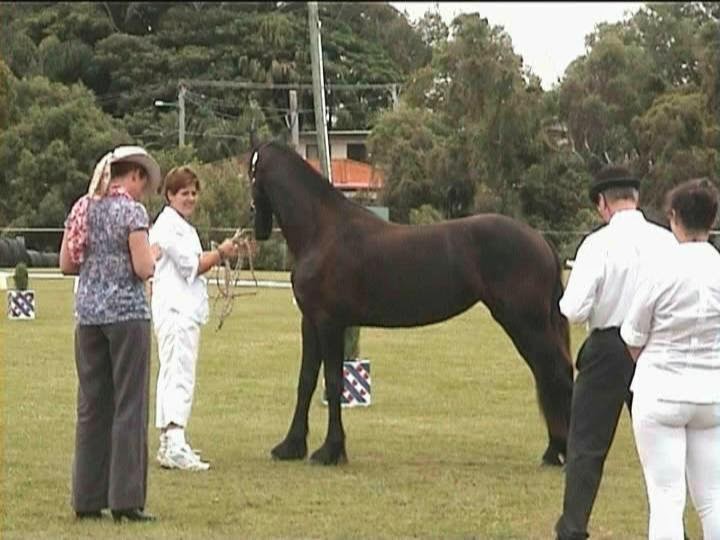
The ANZFHS is the official representative of the Royal Society “The Friesian Horse Studbook”, Koninklijke Vereniging Het Friesch Paarden Stamboek (KFPS), based in the Netherlands. The KFPS is recognised as the World Wide Studbook for the Friesian horse and is the world-wide authority on the Friesian horse. The KFPS has organised the national societies in the World Friesian Horse Association (WFHO)
The ANZFHS currently covers Australia and New Zealand and was established in 1983, celebrating its 25th anniversary in 2009. The first Friesian horse arrived in Australia in 1977 (the stallion Lyckle “B”).The ANZFHS uses the ANZFHS wiki space for discussions between members and you can follow us on our facebook page.
We invite you to explore the world of the Friesian horse if you are new to the breed. If you are already familiar with the breed, or are a member of the ANZFHS and if you are lucky enough to own a Friesian horse, this site will provide you with news, information, photos and items such as the information pack, rules and regulations and the constitution that can be downloaded for your use. Most forms for membership, registration and transfers are also downloadable from this site.
You might be on the verge of joining the small but growing group of Friesian horse owners in Australia and New Zealand. Our website will provide you with information about the rules and regulations and provide you with the procedures how to join as a member, transfer horse ownership or register a horse in the books.
Friesian horse numbers are now close to 600 and are located throughout Australia and New Zealand. The ANZFHS can provide details of breeders and owners in your area. Every 2 years, the ANZFHS organises a “keuring” tour (inspection and classification). The inspections are done by a jury from the mother studbook the KFPS. The next one will be in March / April 2015.
Friesians are becoming quite successfull in the dressage arena. Two stallions in Australia, Abe (Ebony Park Abe) and Django of Cacharel are competing at Grand Prix Level. These two stallions have been awarded the Sport Predicate issued by the KFPS. Five other stallions in Australia also have been awarded the Sport Predicate: Hotse d.V., Jacana TK, Hilwert L., Kai and Omer R.S. fan Top en Twel. One stallion in New Zealand also has been awarded the Sport Predicate, Jolmer fan Twillens. The mares Ynke fan de Greidpleats (OZ), Klaske fan ‘e Olde Hoek (NZ) and Ellie fan de Waldhoeve (NZ) have also been awarded a Sport Predicate. This means they compete at least at Medium Level. The mare Tieke van ‘t Lansink has been awarded a Sport Predicate in Harness.
A judging guide to Friesians is available below.
The ANZFHS registers only Purebred Friesian horses of which the parentage can be determined. The ANZFHS offers assistance with the purchasing and breeding of Friesian horses.
The breeding of Friesians is strictly controlled and depending on the parentage of a horse they will recorded in a specific book. There are no approved studbook stallion in Australia or New Zealand. We have a number of foalbook stallions with a breeding permit. If you are purchasing a Friesian horse and there is any uncertainty of the breeding of the horse and its registration status, please contact the society. We can provide you with details about the status of the horse in the studbook. Unregistered horses may not be able to be registered.
You will find information about stallions here.
Tips to Make Winter Stable Chores Less Miserable
- While it’s tempting to dress like the Michelin man to venture out for barn chores, mobility remains an issue. Layering is the key to comfort and maneuverability. Once you start mucking stalls and dumping buckets, you’ll warm up fast, so the ability to shed layers is important. Start with a base layer of silk long underwear or leggings to wick away moisture.
- Layering latex surgical gloves under your work gloves can help hands stay warm and dry.
- Watering is one of the biggest challenges in winter, whether horses live outside or come into stalls. Heated water buckets are a blessing, but even just insulated buckets will help to keep water from freezing solid.
- Leaky hose fittings can be more than a pain: They can be dangerous if they leave behind a large patch of ice on walkways or the barn aisle. Repairing or replacing them takes only minutes, but will prevent lots of hassle in the coming months.
- Along the same lines, consider purchasing a heated hose or a heated hose cover, which will save you from having to drain the hose after each use or risk dealing with a frozen hose that can’t be used.
- Painting a piece of plywood black and floating it on top of troughs to absorb sunlight can cut down on ice formation (though it will still eventually freeze once temperatures dip low enough).
- For fishing out ice that has been broken apart, an inexpensive fryer basket is exceptionally handy for keeping hands dry while removing ice chunks.
- Consider replacing your plastic pitchfork with a metal one for the winter. Metal tines will work better for picking up frozen manure and are less likely to break.
- Like car and trailer tires, wheelbarrow tires can lose air as well. Be sure all fires are well filled for better maneuverability on slippery footing.
- We all know what a pain it can be to try to dip out some topical wound salves only to find them frozen solid (not to mention this can cause them to lose their efficacy). Move these products and other liquids to a temperature-controlled area like a tack room, feed room or even inside your home so they will be ready to use when you need them.
- While it's an an expensive investment, if you live in an area that utilizes well water, it may be worthwhile to invest in a generator that can run your well pump. The loss of electricity during a winter storm means the loss of water, which can have devastating effects on equines.
- If you store your hay in a building other than your barn, consider hauling it to your horses on a toboggan, which glides readily over the snow.
- Place snow shovels and salt, sand or kitty litter near barn doors so they are easy to locate once snowy weather strikes.
Subscribe to:
Posts (Atom)